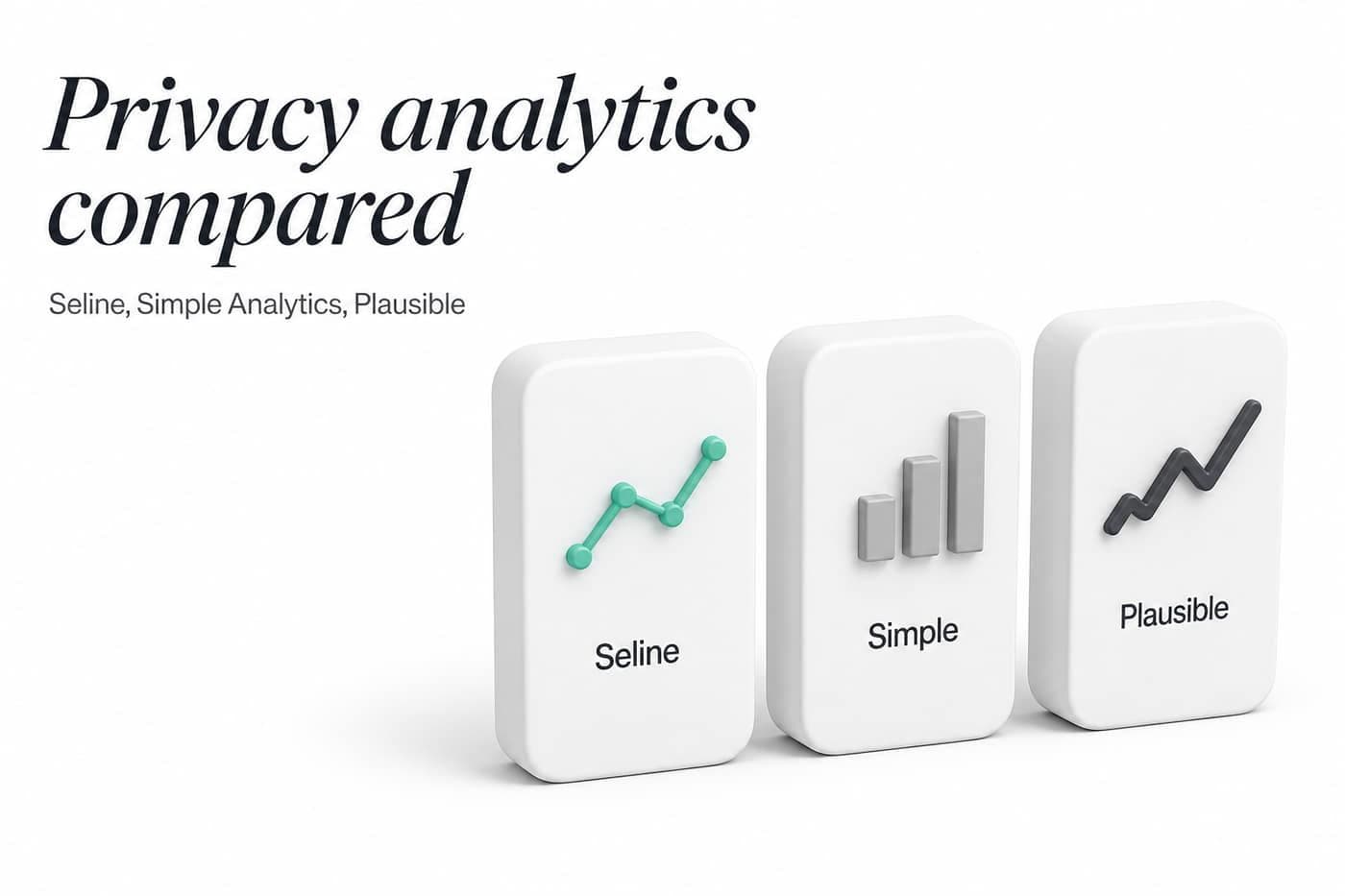
If you run one blog and want $0 forever, pick Simple Analytics on the hobby plan. If you run a fleet of side projects and need funnels without deleting old sites, pick Seline. If you want the cheapest paid chart for a single domain, or you will self-host, pick Plausible.
That is the whole decision in one sentence. The rest is where each tool stops being interchangeable.
| Dimension | SelineProduct analytics | Simple AnalyticsMinimal traffic | PlausibleLightweight + OSS |
|---|---|---|---|
| Cost | 7-day trial. Paid from about $9/mo at 25k events. | Free forever hobby plan. Paid from $20/mo at 100k pageviews. | 30-day trial. Starter from $9/mo at 10k pageviews. |
| Permanent free? | Trial only (no permanent free plan) | Yes. Badge required on free. | Trial only on cloud |
| Sites per account | Unlimited on one subscription | 5 on free. More on paid. | 1 on Starter. Up to 10 on Business. |
| Data history | Forever retention on paid | 1 month on free. Longer on paid. | Up to 3 years on lower tiers |
| Billing unit | Monthly events (pageviews + custom events) | Datapoints scale with traffic | Pageviews + custom events count together |
| Conversions | Funnels, journeys, revenue, API on every paid plan | Goals and events. No full funnel builder. | Funnels and API on Business ($19/mo) only |
| Ad-block gap | Proxy subdomain bypass included | Enterprise “traffic recovery” only | No built-in bypass |
| Self-host | No | No | Yes (Community Edition) |
| Consent banner | Cookieless. No banner required. | Cookieless. No banner required. | Cookieless. No banner required. |
What privacy-first analytics actually measures
Privacy-first analytics means you count visits and actions without cookies, fingerprinting, or selling data to ad networks. All three tools on this page fit that definition. None of them need a GDPR consent banner for basic page tracking in the usual EU setup.
What they do not agree on is depth.
Traffic-only tools answer: how many people came, from where, on which page. Product analytics adds: which path they took, which button they clicked, whether they came back, whether they paid. That second layer costs more engineering on GA4. On these tools it mostly costs plan tier or event quota.
Before you compare prices, decide which question you are actually trying to answer:
- "Is this post getting search traffic?" → any of the three works.
- "Did signup → activate → pay happen on this micro-SaaS?" → you need events and probably funnels.
- "How much traffic am I losing to uBlock?" → you need an ad-block bypass or you are guessing.
I wrote the wider field guide in privacy-first Google Analytics alternatives. This page is the three-way fork I keep getting asked about.
Pricing is three different games
These products do not price the same unit. That is why comparison posts that only list "$9/mo" lie by omission.
Seline bills on monthly events. Pageviews and custom events both count. One plan, every feature included, slider on the pricing page. Entry is about $9/month at 25,000 events. No per-site fee.
Simple Analytics bills on datapoints that scale with traffic. The hobby plan is free forever: one user, five websites, one month of history, and a badge on your site. Paid starts around $20/month for 100,000 pageviews. Unlimited pageviews on free sounds generous until you remember you cannot see last quarter.
Plausible bills on pageviews plus custom events in one bucket. Starter is $9/month for one site at the 10k band. Growth ($14) adds three sites and teammates. Business ($19) adds funnels, revenue tracking, and the Stats API, still capped at ten sites. Annual billing shaves two months. You can also self-host the Community Edition and pay hosting instead of license fees.
Custom events are the silent tax. On Plausible, every tracked click eats the same quota as a pageview. On Seline, same model. If you instrument heavily, budget higher before you blame "slow SEO."
Simple Analytics: free forever, shallow history
Simple Analytics is the tool I used for five years. It does exactly what the name says. One dashboard, referrers, countries, basic goals. No GA-style rabbit holes.
The hobby plan is still the best $0 option in this trio:
- Five sites on one account
- Unlimited pageviews with fair-use limits
- 30-day history only
- Badge required on the free tier
For a personal blog you update twice a month, that is fine. For a directory where you need to compare this January to last January, it is not.
Paid Simple Analytics is competitive and transparent. It is also where I hit the wall. When I passed ten sites, I was deleting old projects from the dashboard to make room for new ones. The 2024 pricing reshuffle moved datapoint limits around, but the real pain was site caps and history, not the dollar amount.
Simple Analytics still wins on trust and minimalism. If your site is one URL and you want the quietest possible chart, start here. You can always outgrow it.
Plausible: cheap traffic, pay for depth
Plausible is the default recommendation on Hacker News for a reason. Fast script, clean UI, open-source core, EU hosting. For a single content site, Starter at $9/month is hard to beat.
The constraints show up when you scale horizontally or vertically:
- One site on Starter. Three on Growth. Ten on Business. Past that you are in Enterprise quotes.
- Funnels, journeys, revenue, and API sit on Business ($19/month at the low band), not the entry tier.
- No built-in ad-block bypass. You see what loads your script. Ad-block users simply disappear from the chart.
- Self-hosting is real. Community Edition is free software. You own updates, backups, and uptime.
I recommend Plausible when someone says "I have one newsletter site and I want the simplest honest numbers." I do not recommend it for my own fleet of ten micro-tools where I want funnel steps on the base plan and I do not want to delete old-project-2023.com to add a new directory.
Seline: many sites, blocked traffic, product metrics
Seline is what I run now across side projects, including every micro-tool I ship on the Next.js stack. I moved off Simple Analytics for three concrete reasons, not marketing adjectives:
- Unlimited websites on one subscription. I stopped archiving dead domains just to stay under a site limit.
- Ad-blocker bypass via proxy subdomain on the standard plan. My dev audience blocks
analytics.jspatterns. Without bypass, I was undercounting by double-digit percentages on some tools. - Funnels and journeys on the base plan. I did not want Business-tier Plausible pricing just to ask "how many people hit pricing after the docs page."
Seline is event-priced like a product analytics tool, not a pageview counter. That is a feature if you track button clicks and signup steps. It is overhead if you only wanted a line chart of daily visits.
Honest downsides:
- No permanent free plan on the hosted product. You get a 7-day trial, then you pay. Simple Analytics beats it on $0.
- No self-host option. You are buying SaaS or you are not.
- Younger product. Plausible and Simple Analytics have longer track records. I accept that trade because the dashboard and API match how I actually debug launches.
I wrote the full migration story in switching from Simple Analytics to Seline. Short version: export what you can, run both scripts for two weeks, compare referrers, then drop the old snippet.
Seline links on this page are affiliate links.
Where ad-blocker bypass actually matters
Privacy tools are ironic here. The same audience that cares about cookieless analytics often runs uBlock Origin. First-party proxy subdomains (Seline ships this on paid) route the script through your domain so block lists that target plausible.io or simpleanalytics.com do not fire.
None of that is magic. Determined blockers still win. Enterprise "traffic recovery" on Simple Analytics is a different product line entirely.
Rule of thumb from my projects:
- Developer or ad-block-heavy audience → count on missing traffic unless you proxy.
- General consumer content → raw script is usually "good enough."
- Revenue decisions (ad network applications, sponsor pitches) → do not guess. Measure the gap or you will under-report sessions.
That ties back to the monetization funnel in domain rating vs traffic vs revenue. Ad networks ask for sessions, not your gut feeling.
Which one I pick
One blog, $0 budget
Simple Analytics free
Five sites, unlimited pageviews on the hobby plan. You trade a footer badge and 30-day history for not paying yet.
Many micro-sites + funnels
Seline
Unlimited sites on one bill, ad-block bypass without an enterprise quote, and funnels on the base plan. This is why I switched.
One site, open source
Plausible Starter or self-host
Cheapest honest traffic chart for a single domain. Self-host the Community Edition if you want $0 license and you will run the server.
Personal blog, no budget. Simple Analytics free. Accept the badge and 30-day window.
Directory or tool with SEO goals. Seline on paid. I want year-over-year referrers and signup funnels without juggling site slots.
Client's marketing site, one domain. Plausible Starter. Hand them a clean dashboard, bill the $9 through the project fee.
Compliance team that demands on-prem. Plausible Community Edition or Umami (covered in the nine-tool roundup), not Seline.
Migration checklist (any direction)
- Install the new snippet in your layout or tag manager. Keep the old one running.
- Wait 14 days so weekday/weekend cycles even out.
- Compare totals, not page-by-page. Different tools define "session" slightly differently.
- Re-create goals as custom events. Names will not import one-to-one.
- Update your privacy policy with the new processor name.
- Remove the old script only after you have one full week of solo data you trust.
If you are leaving Google Analytics entirely, read why I stopped using Google Analytics first. The hard part is not the script tag. It is breaking the habit of logging into GA4 for a number Simple Analytics already shows on one screen.
FAQ
Is Seline Analytics free?
Not on the hosted product. Seline offers a 7-day trial with no credit card. After that you pick a paid tier based on monthly events. Simple Analytics is the better answer if you need free forever.
Seline vs Plausible for a SaaS landing page?
Plausible if you only need traffic sources and outbound link clicks on one domain. Seline if you track signup steps, profile visitors across sessions (still cookieless), or connect revenue. Plausible puts funnels on the Business plan. Seline includes them on the base paid plan.
Simple Analytics vs Plausible for bloggers?
Both work. Simple Analytics free wins on price if you tolerate the badge and short history. Plausible Starter wins if you want no badge, longer retention, and you only have one site. I used Simple Analytics for years as a blogger before the site-count pain hit.
Do these tools work with Next.js App Router?
Yes. Drop the script in app/layout.tsx or use their framework guides. For a repeatable deploy pattern, see the ops section in micro-tools with Next.js and Vercel.
Which tool is most GDPR-friendly?
All three market GDPR compliance and EU hosting. None require cookies for basic analytics. Your legal text still needs to name the processor. I am a developer, not a lawyer. If compliance is the primary buying reason, run the vendor's DPA past whoever signs those at your company.
Try Seline (7-day trial)