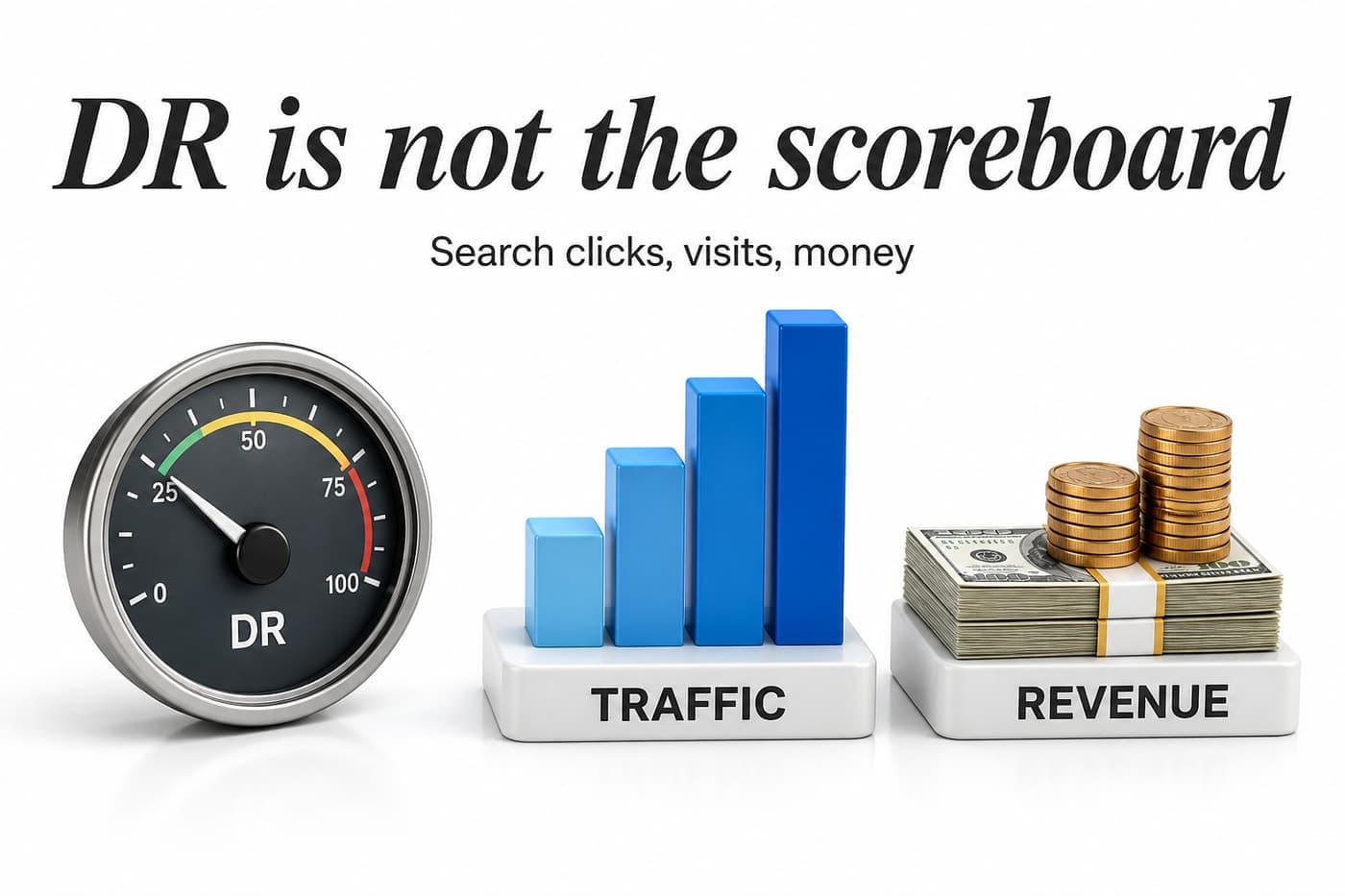
Domain Rating will not cash a check. Ad networks do not ask for your Ahrefs screenshot.
They ask how many sessions or pageviews you had last month, where those visitors came from, whether the content is original, and whether your layout can run ads without looking like a trap. DR is one input that might help you get there. It is not the finish line.
01 Links
Domain Rating
Ahrefs-style backlink score. Lagging. Can rise without clicks if the links are junk.
02 Search
Clicks and CTR
Did someone choose your result? Impressions without clicks is not traffic.
03 Visits
Sessions / pageviews
What ad networks count. Google Search is one channel. Direct and social count too.
04 Ads
Network tier
AdSense at low volume. Premium and marketplaces after thresholds and quality review.
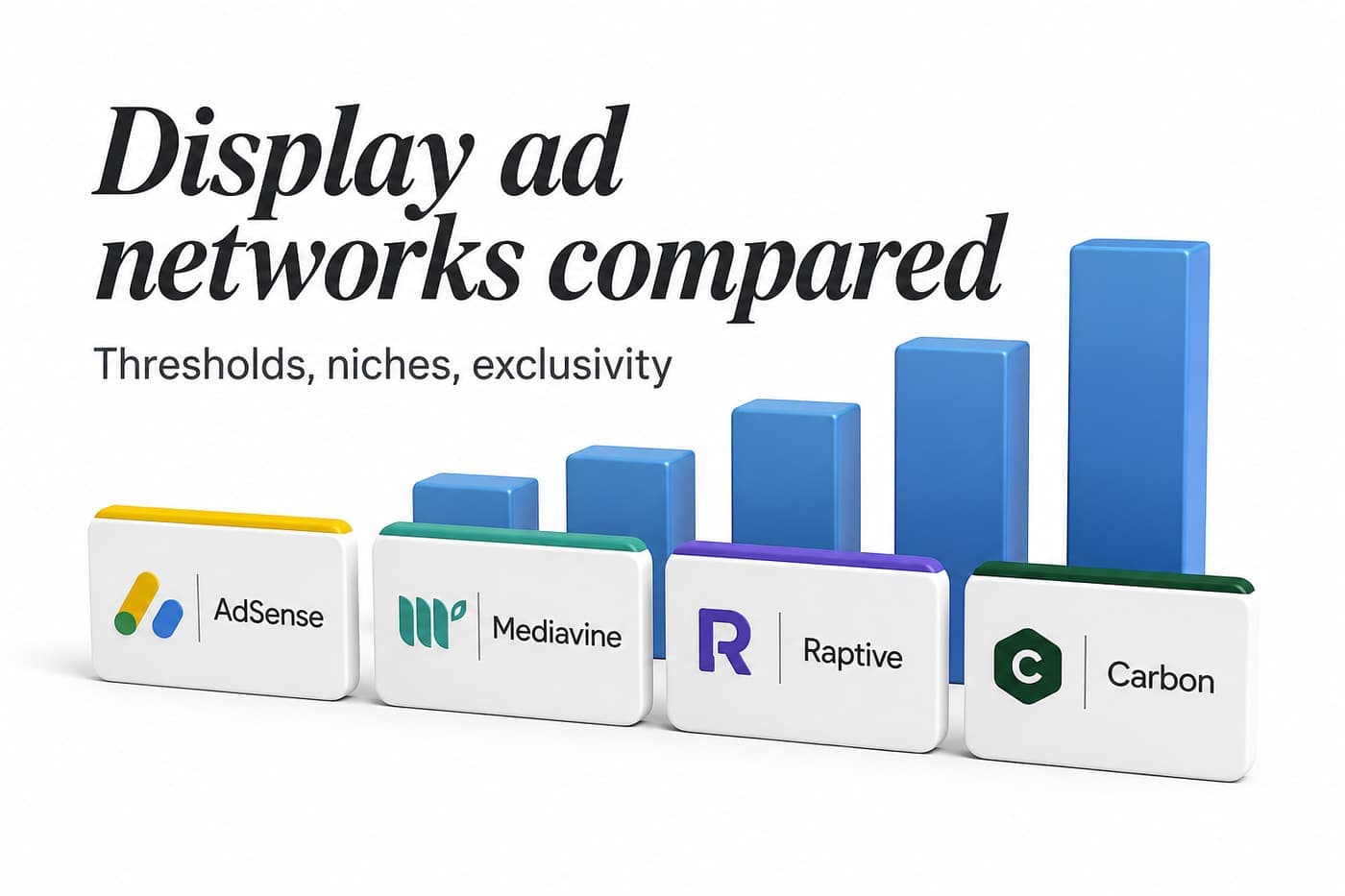
This page is the chain: links, rankings, visits, ad eligibility, money. Link-building tactics live in how I increase domain rating on side projects. Network names, thresholds, and exclusivity rules are in the display ad networks comparison. Thresholds change. Check each vendor before you apply.
What Domain Rating measures (and what it does not)
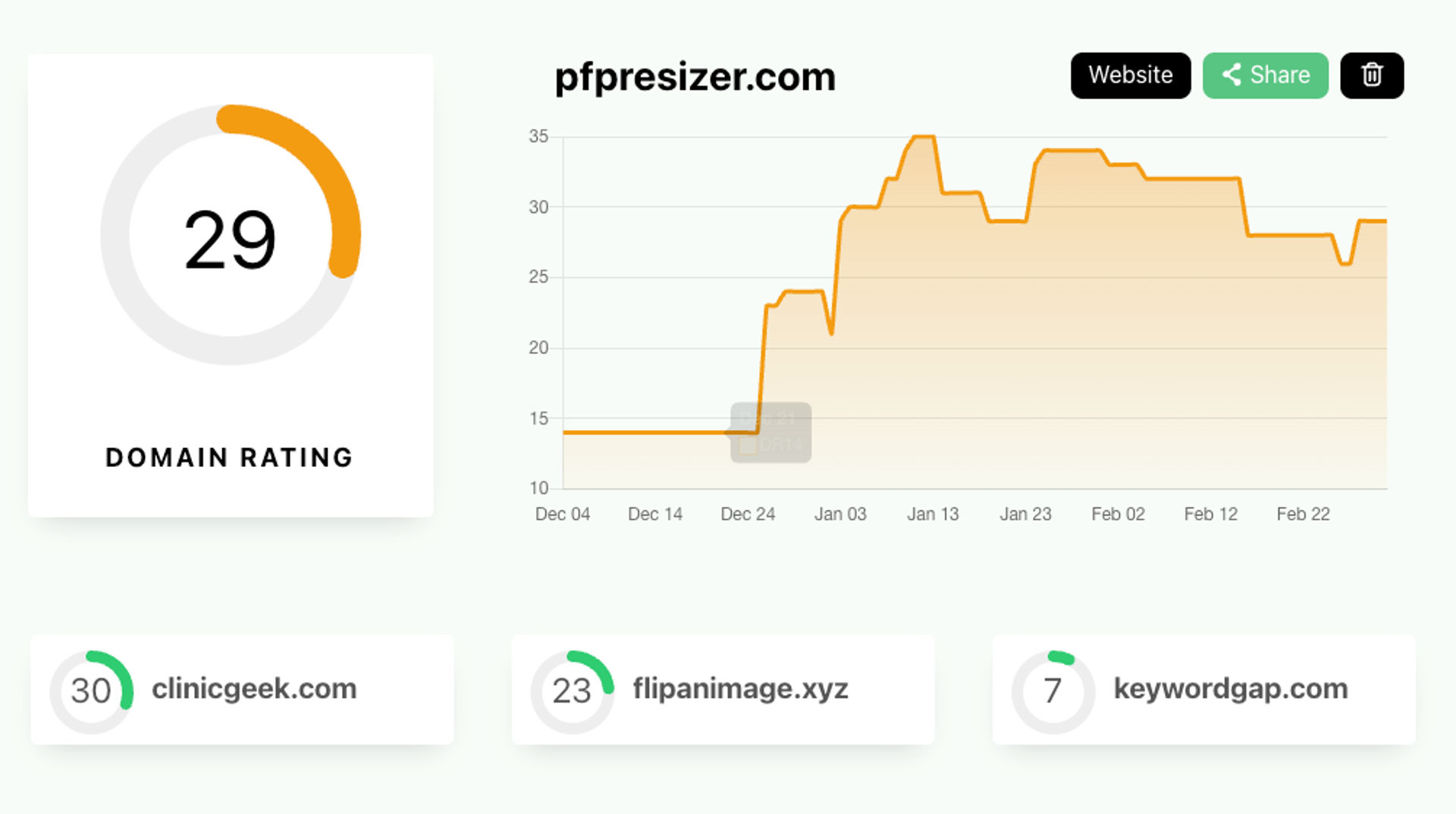
Domain Rating (DR) is Ahrefs' 0 to 100 estimate of backlink strength. Moz calls it Domain Authority. Semrush calls it Authority Score. Same idea: a third-party model of who links to you.
Google does not read DR. Google uses links as one signal among many. A vendor compresses "we saw links" into a number you can screenshot. That is useful for spotting spam spikes and comparing two sites in a sales deck. It is a bad weekly KPI.
DR can rise while traffic flatlines. Bought links, footer networks, and irrelevant directories move gauges. They do not move users. DR can also sit low while a narrow site prints clicks, because the query is specific and the page matches intent. Long-tail utility pages do this all the time.
I watch DR in FrogDR like a tire gauge. Sudden jump, I look for junk. Slow crawl after shipping pages people cite, fine. I do not pick ad networks from DR. FrogDR links on this page are affiliates.
How DR affects traffic (when it actually does)
Links help rankings indirectly. A relevant link is a vote that your URL is worth showing. More visibility can mean more impressions. Impressions are not traffic until someone clicks.
The path looks like this:
- Earn or build links (guest posts, directories you belong in, tools people embed, citations).
- Rankings move for specific queries, not for the whole domain at once.
- Impressions rise in Search Console for those queries.
- CTR decides clicks. A position 8 result with a weak title gets skipped. A position 4 result with a clear title wins.
- Sessions show up in analytics. Some from Google. Some from Reddit, newsletters, bookmarks.
DR is step 1's lagging report card. Steps 4 and 5 decide whether step 1 mattered.
Common failure modes:
Impressions without clicks. You rank on page one for a broad query and nobody chooses you. DR did its job. The snippet did not.
Clicks that bounce in ten seconds. You ranked for the wrong intent. Ad networks notice engagement and geography, not only raw pageviews.
Traffic from the wrong country. Premium networks weight US, UK, Canada, Australia, and New Zealand. Raptive publishes geo share rules alongside its pageview minimum. High DR with India-heavy traffic still gets rejected.
Programmatic URLs that rank but do not convert. Thousands of thin pages inflate impressions and wreck average position. DR will not fix that. Page strategy will.
If you want tactical link building, use the DR guide. If you want to know whether DR or traffic matters more for monetization, traffic wins every time.
What traffic ad networks actually count
Networks disagree on definitions. Mix them up and you will apply too early or stay on AdSense too long.
Sessions are visits in GA4. Mediavine's Journey program cites 1,000+ sessions as an entry point on its requirements page. Sessions bundle pageviews from one visit.
Pageviews count each load. Raptive asks for 25,000 pageviews per month on its eligibility page, plus Google Analytics installed correctly, original content, and a domain at least six months old for many applicants.
Ad revenue history is newer but real. Mediavine Official asks for $5,000+ in annual ad revenue before you join the main program, as of its 2026 program docs. Journey exists for sites below that line. Revenue is a proxy for "this audience already monetizes."
Human traffic quality shows up in every review: no incentivized clicks, no bot swarms, no scraped content, AdSense policy compliance, readable layout. You can hit a pageview number with junk traffic and still get rejected.
Niche and layout matter as much as volume for marketplaces. Carbon Ads targets developers and designers, reviews pageviews, and accepts by invitation. BuySellAds is a direct marketplace: advertisers pick sites they want to reach. A 15K-pageview dev blog can qualify where a 80K gossip blog does not.
None of these screens ask for DR.
From traffic to ad network approval
Think in tiers, not one magic network.
Tier 0: Almost no traffic
Under a few thousand monthly pageviews, display ads are mostly symbolic. Google AdSense has no published traffic minimum, but you still need original content, policy compliance, and age 18+. Payouts often sit below the $100 threshold until volume grows.
Affiliates, a single sponsor, or a product beat premature AdSense optimization. I would not rewrite the whole site for RPM at this stage.
Tier 1: Proof of concept (roughly 1K to 10K sessions)
Journey by Mediavine (1K+ sessions per Mediavine), Monumetric Propel (~10K pageviews, WordPress/Blogger focus), Media.net, and AdSense are realistic targets. Carbon and BuySellAds are worth a shot if the audience is technical and the design is clean.
This is where DR work pays off if it produced clicks on intent-matched queries, not if it only moved a gauge.
Tier 2: Mid-scale (roughly 25K to 50K pageviews)
Raptive lowered its published minimum to 25,000 monthly pageviews (with geo rules for sites under 100K). That opened the door for sites that are not yet at the old 100K bar but have US-heavy traffic and long-form posts.
Compare Mediavine Official ($5K annual ad revenue) vs Journey (sessions). You might run Journey, prove revenue, then graduate.
Tier 3: Premium and hybrid
Above premium thresholds, RPM and ad ops matter more than which network "accepts" you. Exclusivity clauses matter too. Many managed networks require you to drop competing programmatic stacks. Read the contract before you celebrate approval.
The full table, payment terms, and exclusivity notes live in the network comparison.
Under 10K pageviews / month
AdSense, affiliates, sponsors
Premium networks will reject you or pay pennies. Fix CTR and pages first. Direct sponsors beat bad programmatic.
10K to 25K pageviews
AdSense + Monumetric Propel or Media.net
Managed lift without Raptive scale. Carbon or BuySellAds if the audience is dev/design and the layout is clean.
25K+ pageviews, US-heavy
Raptive or Mediavine path
Raptive wants 25K pageviews and geo mix. Mediavine Journey starts around 1K sessions; Official wants $5K ad revenue first.
Dev / design / SaaS blog
Carbon or BuySellAds before lifestyle networks
RPM on a 30K dev blog can beat a 100K generic blog. Match network to advertiser demand, not only pageviews.
Why DR alone will not get you into a premium network
Premium and marketplace networks sell audience to advertisers. DR is a SEO metric. Advertisers buy sessions in valuable geos reading valuable content.
A site can have DR 40 and 500 monthly sessions. Rejected.
A site can have DR 15 and 40,000 US pageviews on tutorial content. Accepted to Raptive, rejected from Carbon if the niche is wrong.
A site can have 200,000 impressions and 0.3% CTR. DR hunters love the impression line. Ad networks do not pay on impressions you never converted to visits.
DR helps when it correlates with rankings on queries that match your monetizable pages. It hurts when you optimize the gauge instead of the click.
What I would measure instead of DR
Weekly, I would watch:
- Search Console clicks and CTR on money pages, not site-wide averages polluted by junk queries.
- Monthly sessions and pageviews in GA4, with country and landing page reports.
- Engagement: pages per session, scroll depth if you have it, return visits.
- Ad revenue per thousand pageviews (RPM) once a network is live, not before.
Monthly, I would glance at DR and referring domains for spam. Quarterly, I would re-read network requirements because vendors change them. Raptive's 25K minimum and Mediavine's revenue tiers are both recent examples of that.
What I did not choose
I did not treat DR as a prerequisite to apply anywhere. Low DR does not block AdSense. High DR does not bypass Raptive's pageview floor.
I did not assume one network fits every site. Lifestyle blogs, local directories, dev blogs, and free tools hit different demand pools. The comparison page exists because "best ad network" is the wrong question.
I did not stack exclusive networks. Running Mediavine and AdSense on the same inventory is a policy problem, not a life hack. Marketplaces and programmatic stacks have their own rules too.
FAQ
Does increasing Domain Rating increase traffic?
It can, if new links come from relevant pages and your URLs already deserve clicks. DR can also rise without traffic if the links are low quality. Use Search Console clicks as the check, not the gauge.
What traffic do you need for Google AdSense?
Google publishes content and policy requirements, not a session minimum. Practical floor for meaningful payout is often cited around 10K to 20K monthly pageviews because of the $100 payment threshold and RPM. Your niche and geo matter more than any rule of thumb.
When should you leave AdSense for a premium network?
When you consistently clear the network's published threshold, your traffic mix matches their geo rules, and your content fits their advertiser base. Run the numbers: premium RPM lift minus exclusivity and layout control. The comparison walks through the main options.
Do ad networks care about Domain Rating?
Not directly. They care about traffic volume, traffic quality, content originality, layout, policy compliance, and sometimes existing ad revenue. DR is an SEO diagnostic, not an ad application field.
Can a new site with low DR still monetize?
Yes, with AdSense, affiliates, sponsors, or a marketplace that likes your niche. Premium managed networks want volume first. Build clicks, then apply.
What to do next
Pick one money page. Check its queries in Search Console. If impressions are high and CTR is near zero, fix the title and lede before you chase DR.
Once you have stable monthly sessions, open the display ad networks comparison and match your niche and pageview band to a short list. Apply to one network at a time and read exclusivity terms.
If you still need links, use the side-project DR guide. Then return to clicks and pageviews. That is what gets you to the ad signup form.