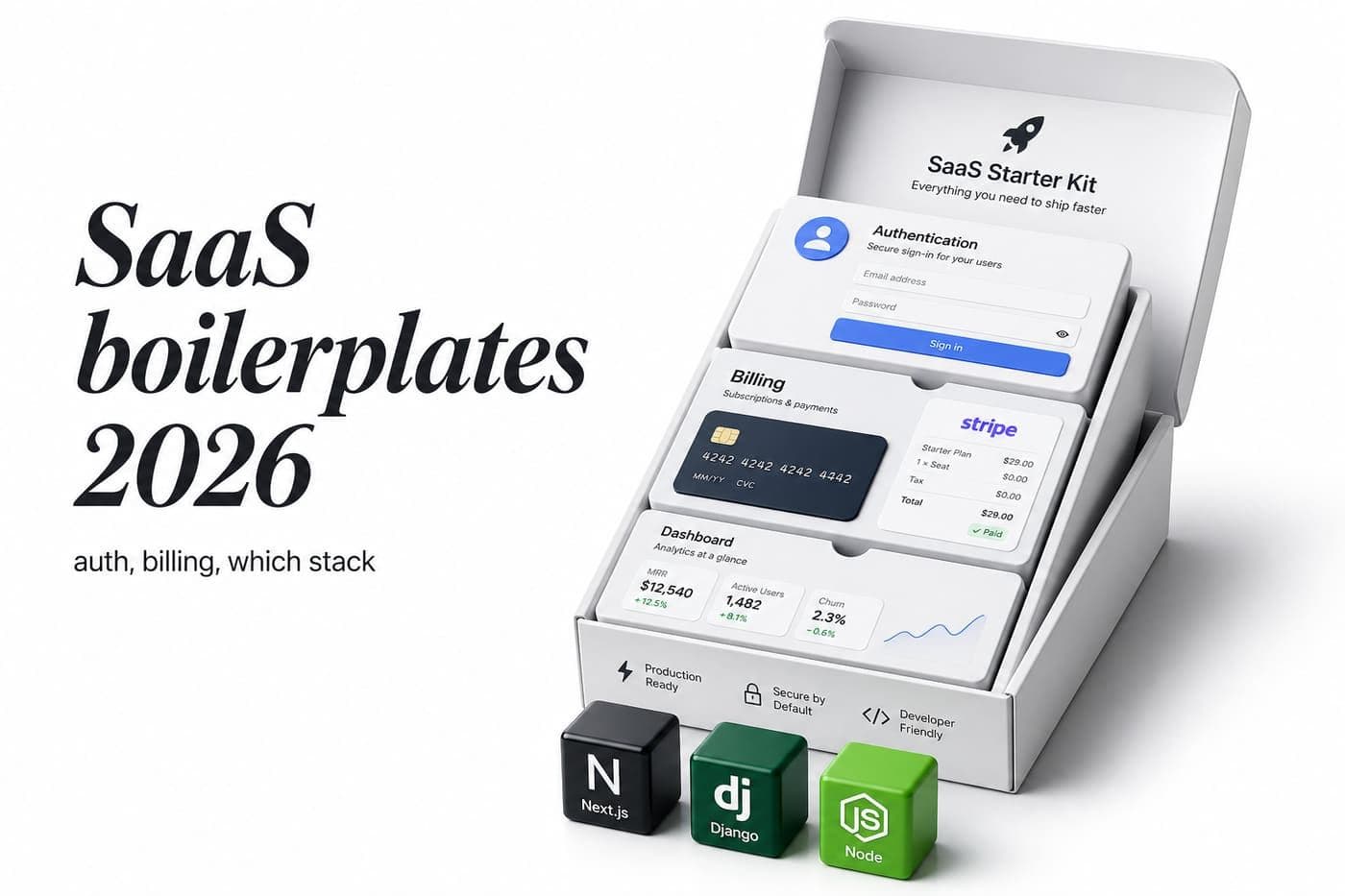
When I built OpenGraph.xyz, I spent more time on landing pages than on the product. A SaaS boilerplate will not stop you from doing that. It will stop you from rebuilding login and Stripe webhooks for the fifth time.
There is no universal "best" kit. There is the stack you already ship, whether you need teams on day one, and whether you will pay for someone else's maintenance. This page is the 2026 map: auth, billing, tenancy, then a pick per stack. Some paid links are affiliates.
| Kit | Stack | Auth | Billing | Multi-tenant | License |
|---|---|---|---|---|---|
| ShipFast | Next.js | NextAuth (Google, magic link) | Stripe or Lemon Squeezy | No | $199 one-time |
| Makerkit | Next.js | Better Auth or Supabase Auth | Stripe or Polar | Yes, orgs and RBAC | $349 Pro, one-time |
| supastarter | Next.js, Nuxt, TanStack | Better Auth | Stripe, Lemon Squeezy, Polar | Yes, orgs and roles | €349 Solo, one-time |
| SaaS Pegasus | Django | Django auth, social on paid | Stripe (paid edition) | Teams on paid | Free OSS, paid from ~$449 |
| Gravity | Node.js + React | Email, social, 2FA | Stripe, seats, usage | Yes, organisations | Paid, yearly updates after year 1 |
| Next.js SaaS Starter | Next.js | Auth.js | Stripe subscriptions | Shallow teams | MIT, free |
| Open SaaS | Wasp (React + Node) | Email + social | Stripe, Polar, Lemon Squeezy | Shallow | MIT, free |
Prices checked August 2026 against vendor pages. Sale stickers move. Confirm auth and billing on the current docs before you pay.
What a SaaS boilerplate is
A boilerplate is a codebase that already wires authentication, a database, and subscription billing, plus the boring edges: transactional email, a customer portal, env files, often a blog.
A ThemeForest "SaaS template" is a coat of paint. No auth, no Stripe, no schema. Do not pay boilerplate prices for that.
A component library is not a boilerplate either. shadcn/ui will not charge a customer.
If your product does not take money from users, you probably do not need one. AEDLocator and AgentLookup are directories. I did not buy a kit to wrap public data. The lighter stack is in how I ship micro-tools.
Auth and subscription billing are the only columns that matter
The long-tail question I keep seeing is: which kits include user auth and subscription billing out of the box?
Paid kits above all do, except where I noted Pegasus's free edition. On open source, the honest list is short:
| Kit | Auth | Subscription billing | Catch |
|---|---|---|---|
| nextjs/saas-starter | Auth.js | Stripe | MIT. Minimal. You own the rest. |
| Open SaaS | Wasp auth (email + social) | Stripe, Polar, or Lemon Squeezy | MIT. You take on Wasp, not plain Next.js. |
| ixartz/SaaS-Boilerplate | Clerk | Stripe | MIT core. Clerk is a vendor. |
| Pegasus open source | Django auth | No. Stripe subscriptions are paid. | Fine for a hobby. Not a billing kit. |
| Makerkit Lite | Auth + profiles | No. Billing is Pro. | Use it to evaluate Makerkit, not to charge users. |
If the query is literally "open source + auth + subscriptions," start with nextjs/saas-starter (stay on Next.js) or Open SaaS (more batteries, different framework). I would not call Pegasus OSS a billing starter. The comparison table on their pricing page is easy to miss.
I did not run a stopwatch bake-off this month. Anyone publishing "37 minutes to Stripe" without a repo and a date is selling a feeling. The test I would run: clone, env, Google OAuth, one test-mode checkout, deploy. That is the only clock that matters.
If you are on this stack, use this kit
Next.js, solo, B2C, you want to charge this month. ShipFast. Single-tenant. NextAuth. Stripe or Lemon Squeezy. Largest indie community. No orgs, no RBAC, no test suite. That is the product.
Next.js, B2B, teams and roles on day one. Makerkit. Or supastarter if you also want a Nuxt or TanStack Start cousin. Retrofitting tenancy onto ShipFast is the expensive rewrite.
Django / Python. SaaS Pegasus paid, if you need Stripe subscriptions and teams. The free edition is auth and scaffolding, not a payments product.
Node.js without Next. Gravity. Express-era React + Node, organisations, Stripe seats. Updates after year one are a paid add-on. That is the bus-factor trade: a kit that has been sold since 2018, with a renewal.
Zero budget, Next.js. nextjs/saas-starter. You will write more than you would on a paid kit. You will not wait on a Discord.
Zero budget, you will learn Wasp. Open SaaS. Feature-complete and free. The lock-in is the framework.
Vue / Nuxt. supastarter's Nuxt edition. I am not sending you to a 2024 Nuxt kit I have not rechecked.
ShipFast
ShipFast is still the Next.js kit indie Twitter means when they say "just buy a boilerplate."
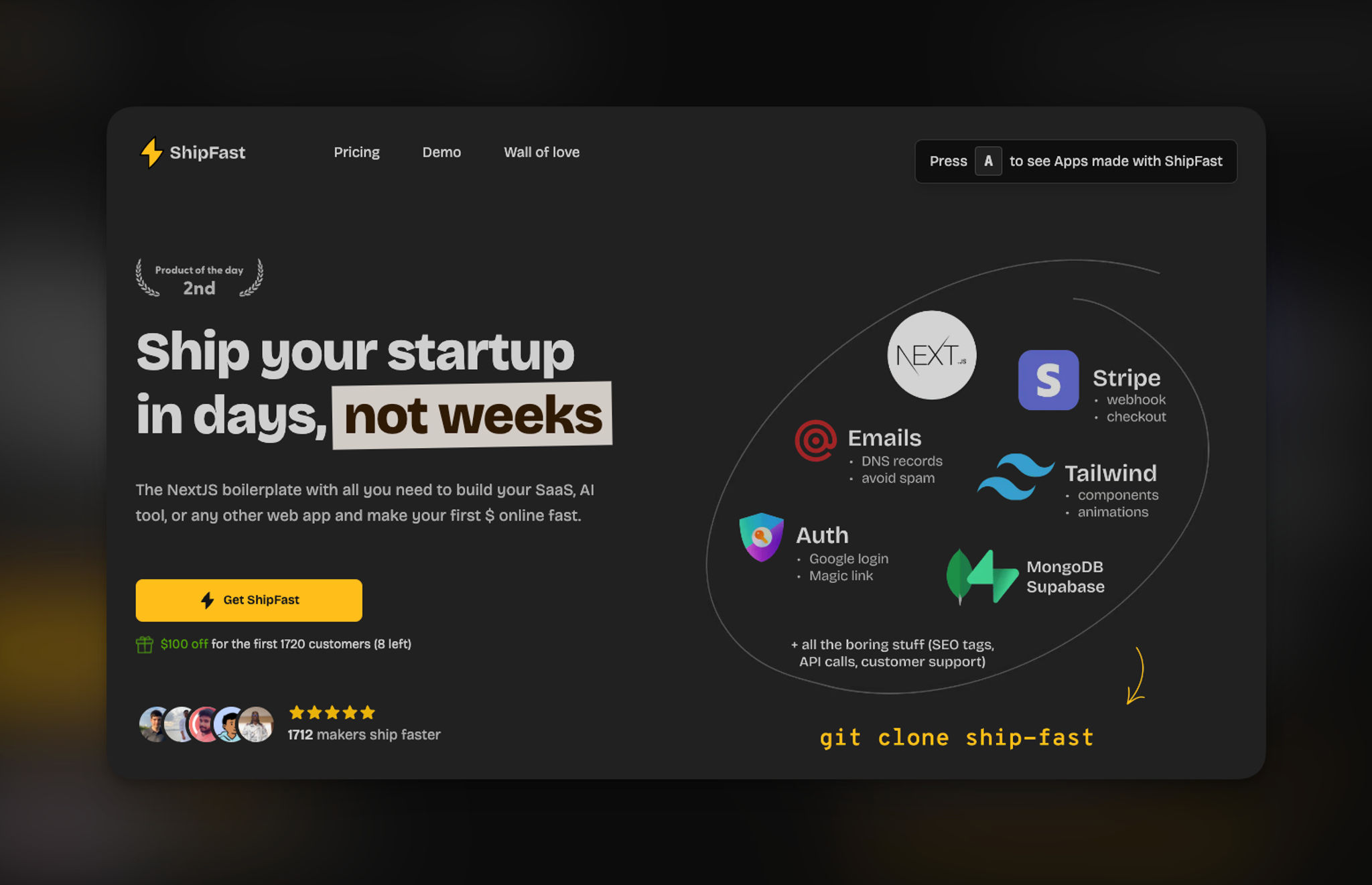
Starter is $199 one-time (their page still shows a $100-off sticker). MongoDB or Supabase, Stripe or Lemon Squeezy, Google OAuth and magic links, Mailgun or Resend, SEO/blog helpers. Unlimited projects. Lifetime updates, with the last public update lagging by months when I checked.
Use it for a single-player SaaS. Do not use it because you might add "workspaces" later. You will.
Get ShipFastMakerkit
Makerkit is the B2B Next.js kit I would look at if ShipFast's missing orgs would hurt in month two. Next.js 16, teams, invites, RBAC, per-account billing, Stripe or Polar. Pro is $349 one-time. There is a free Lite with auth and no billing.
Heavier than ShipFast. That is the point. I have not shipped a product on it. I am not going to pretend I have.
supastarter
supastarter is the multi-framework option: Next.js, Nuxt, TanStack Start. Better Auth, several payment providers, organisations. Solo Next.js is €349 one-time. Pick this if the team is not all-in on Next, or you already live in Nuxt.
A Turborepo monorepo is overhead for a weekend toy. It is normal for a product you will still be in next year.
SaaS Pegasus
SaaS Pegasus is the Django answer. Auth, teams, Stripe subscriptions, impersonation, Wagtail, Celery, Docker. Front end is React or HTMX. Paid Professional is a one-project license around $449. Unlimited is more.
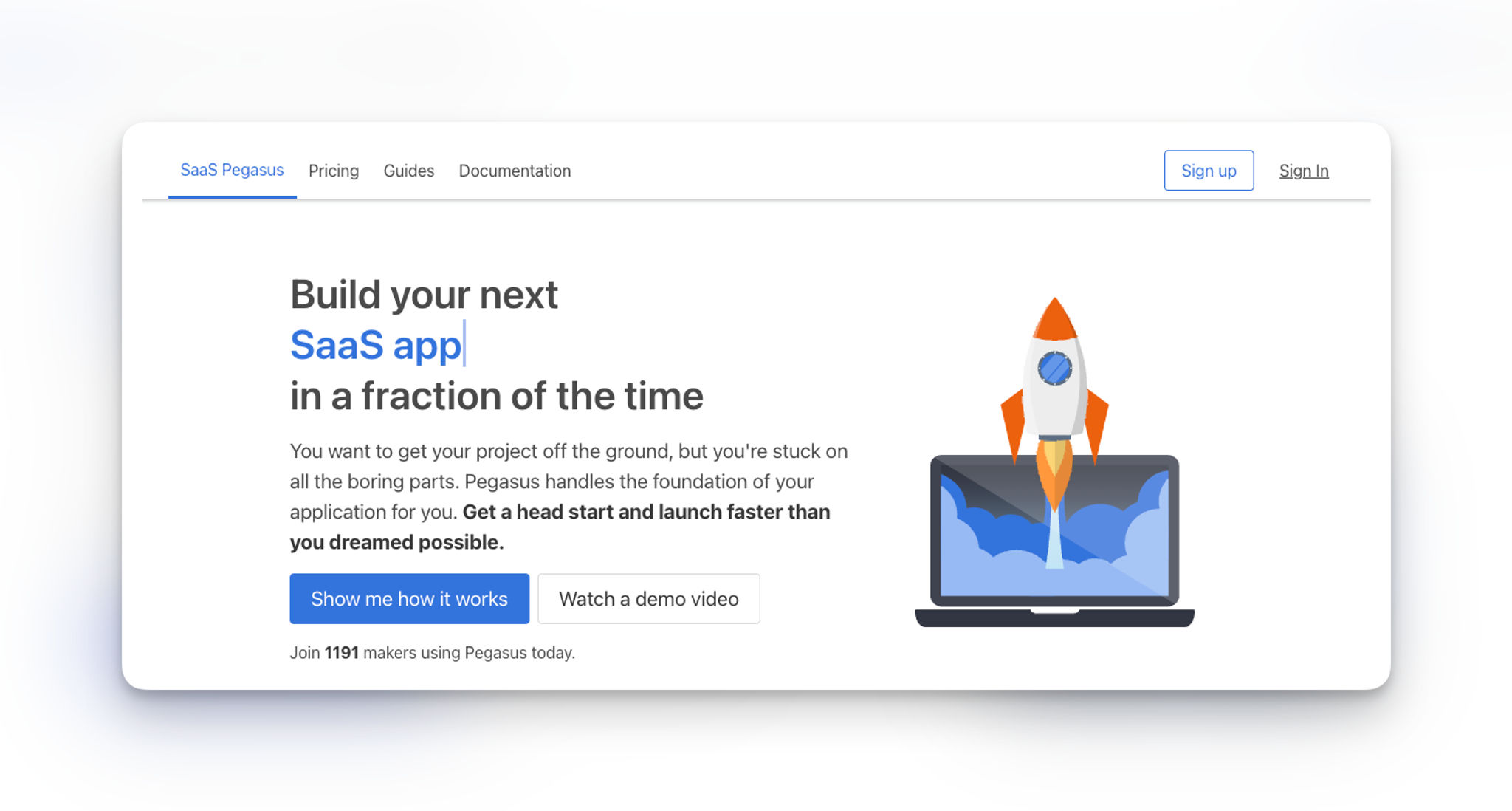
The free OSS edition is useful and incomplete. If your requirement is "open source Django with subscriptions," you are still writing Stripe or you are paying.
Get SaaS PegasusGravity
Gravity is the Node.js SaaS boilerplate that predates the Next.js gold rush. Auth, organisations, Stripe (including seats and usage), a Mission Control admin, optional React Native. They now also sell a Next.js variant. The original pitch is still "I do not want Next."
It is expensive next to ShipFast, and year-two updates are a subscription. Seven years of a paid kit is a better signal than a launch-week Product Hunt clone. If you need node.js saas boilerplate and a separate API server, this is the row.
Next.js SaaS Starter
The official nextjs/saas-starter is MIT, Postgres, Drizzle, Auth.js, Stripe, shadcn/ui. It is a reference for how Vercel thinks a SaaS should be structured, not a Marc Lou tutorial with copy-paste landing sections.
Use it to learn the wiring, or as a base you are willing to maintain. Security patches are "you, and whatever the Next.js team commits." There is no vendor SLA. That is the open-source deal.
Open SaaS
Open SaaS (wasp new -t saas) is the most complete free kit I would actually clone if I accepted Wasp: auth, Stripe/Polar, admin, jobs, S3, Playwright. Wasp compiles to React + Node. You are not writing a vanilla Next app.
If you already think in Next.js file conventions, this will feel like a new language. If you want batteries and a $0 license, it is the serious OSS option.
Security, bus factor, and who patches the Stripe webhook
A boilerplate is a dependency with a face.
Single-maintainer paid kits (ShipFast is Marc) move fast and can go quiet. Check the last commit date, not the landing page. Lifetime updates only help if updates exist.
Company or long-running paid kits (Pegasus, Gravity, Makerkit) still die, but they have a support inbox and a changelog habit. Gravity being explicit about year-two update pricing is more honest than "lifetime" with a six-month gap.
Open source means you fork, you watch GitHub advisories, you bump Stripe SDK yourself. nextjs/saas-starter is MIT and public. That is good for review and bad if you wanted someone else on the hook at 2am.
Before you pay, I would check: last release, whether webhooks verify signatures, whether secrets are documented as env vars, and whether the license lets you ship client work. I would not treat "Discord included" as a security policy.
FAQ
What is the best SaaS boilerplate in 2026?
For a solo Next.js B2C app, ShipFast. For Next.js with teams, Makerkit. For Django, Pegasus (paid, if you need Stripe). For Node without Next, Gravity. For $0 with auth and subscriptions, nextjs/saas-starter or Open SaaS.
Which open-source SaaS boilerplates include user auth and subscription billing?
nextjs/saas-starter (Auth.js + Stripe) and Open SaaS (Wasp auth + Stripe/Polar). Pegasus OSS has auth and not subscriptions. Makerkit Lite has auth and not billing.
Do I need a SaaS boilerplate if I use Next.js?
Only if you will authenticate users and charge them. A content site or a public directory can stay on sitemap.ts and a database. I did not boilerplate AEDLocator.
Is ShipFast worth it vs a free starter?
You are paying for the landing sections, the env tutorial, and the Discord, not for secret Stripe knowledge. If you can wire Auth.js and Checkout from saas-starter in a weekend, keep the $199. If you have already burned two weekends on webhooks, pay.
Should I use a Node.js SaaS boilerplate or Next.js?
If you want one deployable Next app, do not pick Gravity's Express stack to be different. If you already run a Node API and a separate React client, Gravity matches that shape. Next.js kits assume App Router.
What to do next
Pick the row that matches your stack and whether you need organisations. Clone the OSS option for an afternoon if you have never shipped billing. Pay when the webhook file is the thing standing between you and a customer.
Then build the product. Not another pricing section. I already did that on OpenGraph, and it was not the part that sold.